Monday, 19 December 2011

Raiders vs. the Lost ARC

It’s been a busy year for supporters of PCVS and Peterborough’s neighbourhood school network against a hostile takeover by out-of-town forces at KPR.

It was exactly one year ago that ambitious but inexperienced Director of Education Rusty Hick persuaded Trustees to launch the infamous Accommodation Review Committee, or ARC, throwing Peterborough schools into a perverse real-life game of “Survivor,” which Hick himself ended by pointing his imperial finger at PCVS – the most venerable, economical, innovative and academically successful secondary school in the entire Board.

This autumn, the channel has been changed to “Raiders vs. the Lost ARC” as the stalwart supporters of common sense, community-based schools, and PCVS itself have stood shoulder-to-shoulder against the autocratic folly of KPR’s myopic upper management and self-interested or deluded out-of-town Trustees.

At the end of October, the formal petition requesting the Ministry of Education appoint someone to review KPR’s decision went to Queen’s Park. In November, MPP Jeff Leal presented several citizens’ petitions to the legislature, one of which was focused on KPR’s ignorance of Ontario’s plans to increase the population density of downtown Peterborough, as reported in this Examiner article. Even former local PC candidate for MPP Alan Wilson got busy, attempting to set up meetings to lobby Trustees to change their minds. On November 24, a dozen concerned Peterborough citizens, including many experienced and well-respected professionals, formally asked the KPR Board of Trustees to let common sense to prevail and put the brakes on the ill-considered closure decision, while hundreds more occupied the Fisher Drive building.

On December 5, nearly five hundred PCVS students and supporters, led by tireless senior students Matt Finlan and Kirsten Bruce and powered by PCVS’s dynamic drummers, held a hugely successful rally at Queen’s Park, bringing Leal out of the legislature to speak to them. Our MPP told the Examiner that he “admired the engagement and passion” of the PCVS “Raiders,” who reminded him of his own days as a student activist. NDP Education Critic Peter Tabuns also came out to voice his support for the cause.
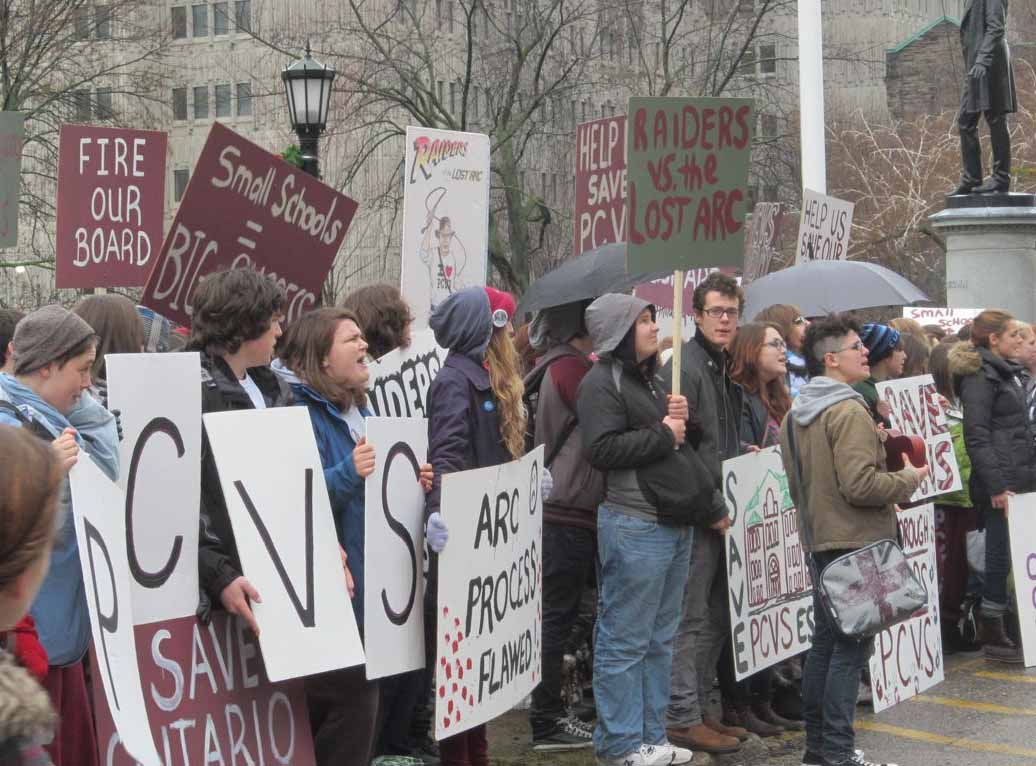


On December 15th, hundreds more PCVS supporters gathered at Fisher Drive as veteran Peterborough Trustee Roy Wilfong, responding to citizens’ requests at the previous Board meeting, made a motion to delay the closing of PCVS by one year. Wilfong’s motion was, predictably, supported only by Peterborough Trustee Rose Kitney and by Norwood Trustee Shirley Patterson, who must sense that Norwood District High will be the next to be closed down as part of KPR’s relentless drive to consolidate control and cut accomodation costs to pay for exorbitant and ill-advised expenditures on technology. At KPR it continues to be the tail that wags the dog, as Hick was allowed by Board Chair Diane Lloyd, over the objections of Wilfong, to behave as if he were an elected Trustee rather than an employee. Hick and Lloyd continued to downplay the enormous ramifications of the decision they obstinately refuse to reconsider, as it was Lloyd’s turn to compare the closing of a thriving, 180-year-old institution, a case of major civic and educational surgery, to “pulling off a band-aid,” as reported by the Examiner.

Asbestos-removal and other renovations at TASSS are expected to cost over a million dollars. Buses to bring students to the inconveniently-located school next year are expected to cost another $200,000. Remember that KPR also paid Don Blair $60,000 to chair the ARC, and ZAS architects $27,000 to provide a prohibitive estimate on converting the TASSS building to board offices. And don’t forget the $7 million in so-called “capital costs” the board has spent this year on computer technology likely to be out of date in five years or so.

Small wonder, then, that KPR adminstration is so desperate to shut schools, deprive French teachers of classrooms, force teachers to buy classroom supplies out of their own salaries, and are reportedly aiming to eliminate preparation time from any elementary teachers without a home-room in the upcoming collective bargaining session.

Let’s do some counting here. On the side of maintaining PCVS we have Wilfong and Kitney (the Peterborough Trustees who actually sat on the Lost ARC), Mayor Daryl Bennett, city council, the DBIA, the Chief of Police, Liberal MPP Jeff Leal, former PC candidate Alan Wilson, the NDP education critic, the entire PCVS school community, and thousands upon thousands of Peterborough citizens, whose tax-dollars supply KPR’s budget.

On the side of closing PCVS, we have seven out-of-town Trustees, one of whom was forced in 1984 to resign his position as MP for Scarborough due to tax-evasion and in 2008 was asked (but refused) to resign his position as Trustee over public comments blaming immigrants for Canada’s problems, one of whom was removed from the Board in 2010 for failing to file his campaign finances, one of whom admitted she had no clue that intermediate schools had been part of the ARC’s focus, and one of whom is a listing agent for substantial property in the TASSS area. We also have the TASSS school community, which is largely composed of students bused in from Keene. Finally, we have the pride of Port Perry and his crew of number-crunchers attempting to manage our school system as if it were a chain of warehouses.

KPR’s response to the Peterborough Needs PCVS petition for administrative review, filed at the end of November, is available on the KPR website. Much of the defense offered by Hick and Lloyd for standing by their tremendously unpopular and autocratic decision amounts to saying “we did the bare minimum – what’s the problem?” I’m sure every KPR teacher has heard this same line coming from the mouths of students who rush through their work as it were a race to the finish line, then approach the teacher’s desk dumbfounded as to why they got a “D.” The document’s opening point says it all, presenting the rationale for closing a school as simply that four secondary schools had an average student population of less than 75%, so therefore only three schools are needed. This gives us confidence that KPR administrators are capable of grade four level math.

Given the emphasis on standardized EQAO testing for all Ontario students, and the requirements of teachers to continually upgrade their credentials, is it not time for administrators to be held to some basic standards? The egregious examples of institutional ignorance before us at Fisher Drive should be motivation enough for the establishment of an “Administrative Quality Accountability Office” – or “AQAO.”

I’m sure it wouldn’t be hard to come up with a battery of questions testing administrative competence to which the brilliant minds at KPR could set themselves down at a desk to answer for a day or two every few years. If we could develop a province-wide test, we could compare results with other Boards of Education, and find out just how poor a job KPR is doing relative to neighbouring boards.

Imagine administrators taking home six-figure salaries at your expense struggling to answer basic questions such as “how many minutes did you spend in a KPR school this year?” and “how many teachers and students do you actually communicate with on a regular basis?” Advanced portions of the AQAO test might quiz administrators on the principles of democracy, urban planning, community well-being, the mental health of children and teens, and even (dare I say it) provincial educational policy.

2012 has to be an improvement on 2011. We’ve already upgraded from “Survivor” to “Raiders vs. the Lost ARC.” Let’s make sure the next show on station KPR continues the trend to better quality "programming" for Peterborough.

Maybe, just maybe, as the Lorax said, if we all care a whole awful lot, sanity will prevail, and our mother tree won’t be looted by Grinches bent on hauling our Whoville gifts back to Fisher Drive.

Dear Santa: I’ve been very good this year. All I’m asking for is not to have the heart ripped out of my neighbourhood. I hope it's not too much to ask.

Thanks in advance,

Brent

PS: the carrots are for the reindeer

Monday, 12 December 2011

Doughnut-Hole Planning and Tax Revolts; or, If It Ain’t Broke, Don’t Fix It

Peterborough has been a model of regular, sustainable growth ever since its incorporation as a city in 1905, just two years before the cornerstone of the current PCVS building was laid. At that time, the former village of Ashburham, known as “East City,” became part of Peterborough, and the system of five wards, representing the north, south, east, west and central areas of the city, was established. Today these are known as Northcrest, Otonabee, Ashburnham, Monaghan and Town wards.

Back then, PCVS was the only secondary school in the city. In 1952, Kenner CVI was built to serve the expanding south end, named after PCVS graduate Hugh Kenner, who had become a notable English professor in the U.S. In 1960, Adam Scott was built in the north end, and as the baby boom children began reaching their teenage years, Crestwood and TASSS were added to the fleet in 1963 and 1967 to serve not only the city’s west and east ends, but also the outlying rural areas and smaller towns.

When the Peterborough city and county school boards merged in 1969, all five high schools were in place and the population of the city was about 50,000 – about 10,000 in each ward.

Forty-two years later, the city’s population is about 75,000 – an average of about 15,000 in each ward. This growth rate is equal to about 1% per year - an eminently manageable rate if there ever was one. The pattern of population growth has been reasonably uniform across the five wards, with Monaghan Ward, now home to over 17,000 citizens, the area which has experienced the most growth. You’d be hard-pressed to find another city in Ontario which has shown a more predictable, steady, and evenly-distributed pattern of growth.

Prior to the 2010 Municipal Election, the City of Peterborough undertook a study to determine whether any changes were needed to the ward boundaries. After studying ten different options, including proposals to reduce the number of wards from five to four, City Clerk Nancy Wright-Laking concluded that the best system was the one already in place. You can read her report here. Wright-Laking wrote that, in addition to the aim of keeping ward populations relatively equal at least ten years into the future, her review team took into account the natural boundaries of the Otonabee River and major thoroughfares (such as Parkhill, Lansdowne, and Monaghan Road) and the distinct characters of the city’s neighbourhoods. No matter how they tried shuffling the boundaries, none of the possible configurations did any better job than the one we’ve been using. If it ain’t broke, the clerk and city council sensibly concluded, don’t fix it.

While the City of Peterborough was reaching this conclusion, the brilliant minds at KPR were thinking otherwise. Having decided to invest huge sums of public money into technology, board managers needed to find ways to economize. The first idea they ran with was the Accommodation Review designed to force one of the city’s five secondary schools to shut down on the premise that fewer schools with more students each would be able to offer more course options.

The ARC, as documented in detail in a series of posts on this blog in November, didn’t have much of an opportunity to look at any aspect of Peterborough’s secondary school network. They weren’t instructed to examine Peterborough’s neighbourhoods, history, or natural boundaries. They weren’t given the City Clerk’s report on ward boundaries as a reference. They weren’t given population projections ten years into the future. They weren’t given any of the tools needed to do the job, in fact, and the sense that the committee members collectively had that something wasn’t right was reflected in their recommendation that a school be closed only as a last resort. Rusty Hick, however, whose personal and professional history is not in Peterborough but in York Region, ignored the group’s sole substantial recommendation, and attempted to charge ahead with a plan to close the last remaining school in Town Ward.

KPR’s complete and utter disregard of the urban geography of Peterborough is most clearly evident from this simple map, showing the empty space at the city's center where PCVS should be.


According to Canada Post letter-carrier maps, fully one-half of Peterborough residences fall within easy walking distance of PCVS, roughly represented by the elliptical area in the center. This shouldn’t be surprising, as the city has in fact grown up around the civic center of which PCVS is a part. In contrast, TASSS and Crestwood were intentionally built on the city’s fringes to accommodate buses bringing students from outside town, and even Adam Scott and Kenner are located closer to the city’s edges than to its core. Note also that TASSS is located less than 1 km from Adam Scott.

The kind of “doughnut-hole” approach to planning in which KPR is indulging is exactly what progressive urban designers and conscientious city staff across North America have been trying to avoid in the past twenty years, learning from the negative examples of decaying industrial towns in southern Ontario and the American midwest.


The Province of Ontario’s policy on development has emphasized the need to limit urban sprawl and increase population density in existing built-up areas. Peterborough’s city planners and councillors have made a concerted effort to encourage re-development of properties in the city’s core - including the former King Edward and Central elementary schools and former school board offices (the latter two facilities now residential apartments, with the old King Eddie site now home to the new YMCA). The express aim of the province and the city is to increase the population density of Peterborough’s downtown area by 50% over the next twenty years.

If KPR isn’t going to provide any full-service schools to Town Ward, why should Town Ward property owners share any of their tax dollars with KPR? What’s to stop Town Ward property owners from simply checking off a different box on their property tax form?

Answer: nothing.

How would the all-knowing KPR number-crunchers feel if Town Ward property-owners suddenly felt like directing their millions of tax dollars to the French Public school system instead of KPR, or the Catholic board, or even the French Catholic board?

Maybe then they’d see the effect of their doughnut-hole planning as they bite into their budgets to find an empty space where the money should be.

Not all new development will be confied to the city’s core, however, as some degree of suburban expansion is inevitable. The area most likely to be next to be built up is the city’s northwest. New subdivisions are already in progress just north of Highland Heights Public School and in the Ravenswood area off Parkhill West. The city has designated the areas around Jackson Creek, much of which is currently outside existing city limits, for development. West of Fairbairn is the Lily Lake Planning Area, while west of Ravenwood is the Jackson Planning Area. On November 7, just five weeks after KPR Trustees voted to shut down PCVS, Peterborough City councillors authorized a $3.5 million upgrade to the pumping station at 1100 Parkhill Road west in anticipation of future residential development in these areas. You can read the utility services report here.


It's obvious that KPR strategists have “no clue” as to the urban evolution of Peterborough, past or future. Instead of acting as if the City of Peterborough exists only to collect property-tax revenues to feed KPR’s budget, the suits at Fisher Drive might consider dropping by City Hall one day, picking up a wall-map, and having a chat with some city planners, or even the Mayor.

Such a visit might even afford them a chance to say hello to PCVS, the "Mother Tree" of Peterborough’s healthy secondary school orchard, to which they are so anxious to put their axes.